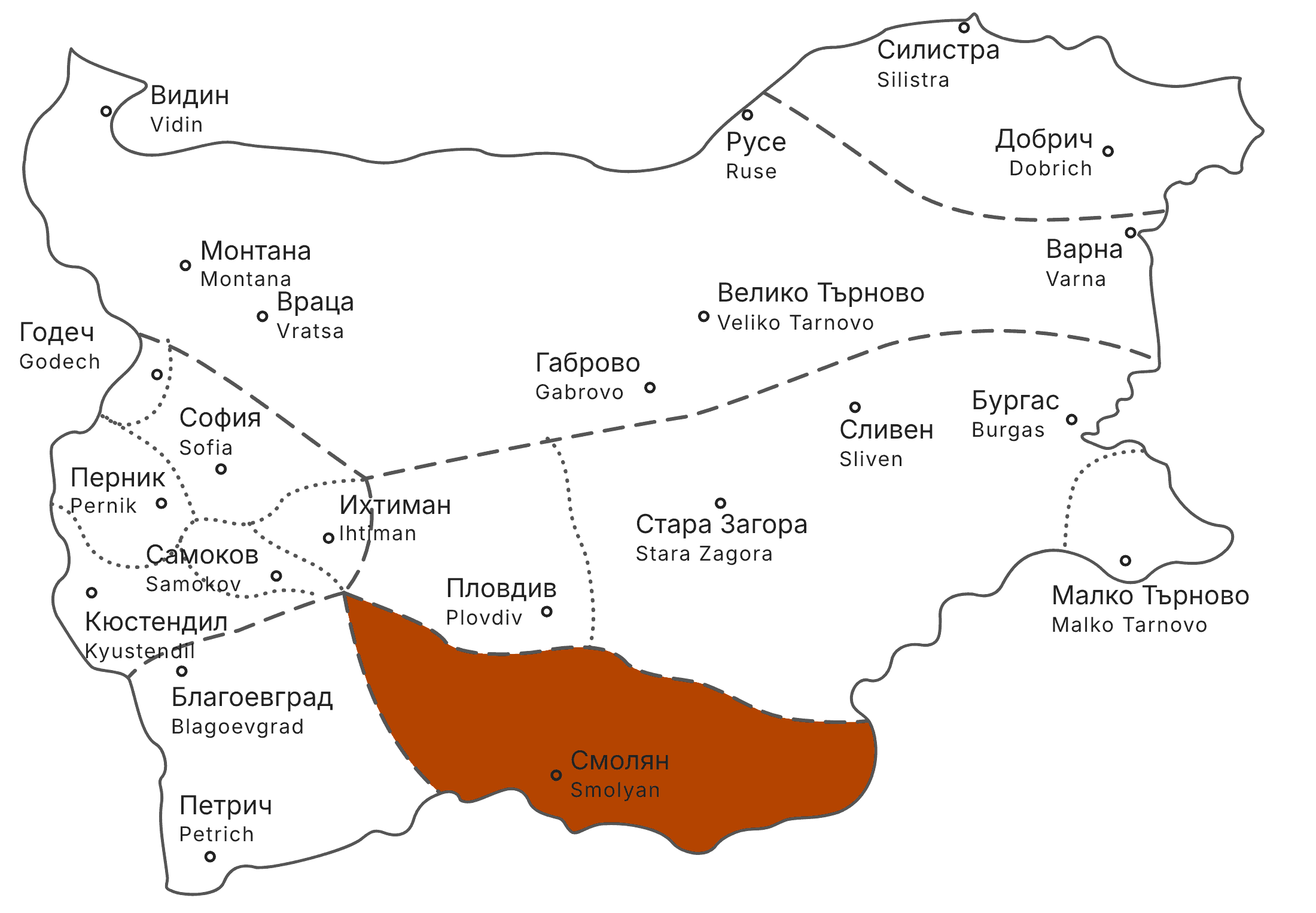
The boundaries of the Rhodope folklore region coincide with the geographic boundaries of the area. The Rhodope Mountains are part of the Rila-Rhodope massif and lie within Southern Bulgaria and Northern Greece. Of the total area of the Rhodopes, 14,738 km² lie within Bulgaria. The mountains cover about one seventh of the country’s territory.
The Rhodope folklore region was once considered a sub-region of the Thracian region. It came to be recognized as a separate region because of the more substantial differences between the two that developed over time.
Origin of the name
The Rhodope folklore region takes its name from the mountain range of the same name – the Rhodopes. Historians find the earliest mention of the name Rhodope in the Homeric Hymn to Demeter from the 7th century BC (among the names of Greek nymphs, heroes and gods).
The name Rhodope as a mountain appears in Herodotus’ Histories, dating from 440 BC. Its exact geographic location cannot be determined with certainty, but in his work Herodotus describes the river Scius, which flows through the middle of the Haemus, from Paeonia (the southwestern parts of the Balkan Peninsula, within today’s North Macedonia, Greece and Bulgaria) and the Rhodope mountain range.
The Rhodopes also appear in connection with a historical event in Thucydides’ History of the Peloponnesian War. He describes the military conflict in Ancient Greece between 431 and 404 BC between Athens on one side and the Peloponnesian League, led by Sparta, on the other. In the same work, he also writes about Thracian tribes living between the Haemus and Rhodope mountains.
Customs of the Rhodope folklore region
The harmony of the mountains is reflected in the everyday traditions of the Bulgarians living there, regardless of their religious beliefs. Two faiths, Christianity and Islam, live side by side in the Rhodopes in peace, sharing preserved folk traditions, customs and language.
The mountains have also shaped the architecture of the houses. Lacking large yards, people built their homes with spacious, wide chardaks (high covered terraces), known in the Rhodopes as potòn. This is the place for merrymaking and dancing the horo at weddings and other family celebrations. In the mountains, people dance rather “gentle” horos named after their setting – “Na chardak” (“On the Terrace”).
Rhodope folk costumes
The women’s Rhodope folk costume differs somewhat between the Christian and Muslim populations. The Christian woman wears a sukman-type costume with a white shirt, a dark woolen overdress (valnenik), a red sash, an outer garment, and the typical, well-known apron of orange, yellow and red squares. Her headscarf is wine red, she wears beautiful strings of gold coins (pendari), and she dances in colorful woolen socks and shoes. The Muslim woman wears a costume with a white embroidered shirt, an embroidered satin garment, a colorful belt with ornate buckles (pafti), and again a checkered apron and a colorful triangular scarf. On her head she wears a small fez with a string of coins, covered with a testemel (a long white scarf). The satin garment may be replaced by shalvari (loose trousers) and a short vest.
The men’s Rhodope folk costume is of the “black-cloth” (chernodreshno) type. The Christian man wears a white shirt, a vest with black braided trim along the edges, and an outer coat. He wears poturi (breeches), a red sash or white leg wraps tied with black cords. Around his neck he wears a wound scarf thrown over the shoulder, and on his head a kalpak, also called a gugla. The Muslim man wears the same costume, but instead of leg wraps he wears colorful socks, and on his head a fez or turban.

Style, form and character of Rhodope folk dances
Rhodope dances are slow and moderate, with little variety of movement and relative simplicity. They are most often danced to song, and a distinctive feature here is that the men sing too.
The horos are danced in a semicircle or circle and are most often for men only or women only. Separated mixed horos also occur, but in them men and women do not alternate side by side; instead, the men join the line first, followed by the women.
Men most often hold each other by the palms, which is very characteristic of the Rhodopes; in other regions this hold is very rare. The men dance with wide steps, squatting and kneeling slowly and heavily.
Women hold by the palms or link arms. A characteristic of women’s dances is that the steps are made entirely on the whole foot. The movements include small hops, but they are very low and restrained. The women always stay in a tight chain, in a circle, close to one another, without spreading out during the dance.
The Rhodopes are also known for special horos and humorous games imitating animals – rabbit, bear and other similar dances.
References
- Rhodopes: Traditional Folk Spiritual and Social-Normative Culture, Ethnographic Studies of Bulgaria (in Bulgarian), Bulgarian Academy of Sciences, Sofia, 1994.
- Bulgarian Folk Horos and Rachenitsas (in Bulgarian), Stefan Vaglarov, Meditsina i Fizkultura State Publishing House, Sofia, 1976.
- Bulgarian Dance Folklore (in Bulgarian), Rayna Kukudova, Nauka i Izkustvo, Sofia, 1955.
- The Rhodopes in Antiquity, Book I: Rhodope as a Reality in the Ancient World (in Bulgarian), Yordan Iliev.
- The Rhodopes in Antiquity, Book II: Ancient Societies in the Rhodopes (in Bulgarian), Yordan Iliev.
- Homeric Hymn to Demeter
- Herodotus, Histories
- Thucydides, History of the Peloponnesian War
Support Taratanci’s mission
With every item from the Taratanci online shop, you support Bulgarian craftspeople and help preserve a piece of folklore for generations to come.