A graphic representation of the Bulgarian folk horo through steps and symbols
You have probably wondered what time signatures actually mean, along with all those musical terms like even meters, uneven meters and metrorhythm. Now let’s see what lies behind these words and how they can help us learn the dance steps of traditional Bulgarian horos.
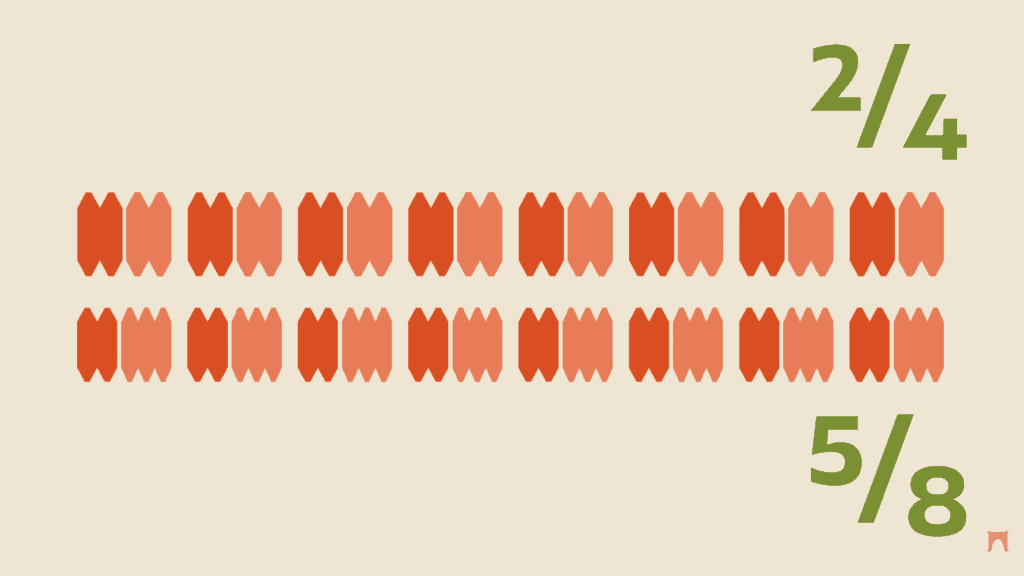
Rhythm
Rhythm is everywhere in nature, and in music it lies in the organized alternation of note durations. But how do we read it? This is where meter comes in, helping us count. In other words, it shows us how to keep time to the horo.
Bar
A bar (or measure) is a section of a piece of music that begins on a strong beat and ends just before the next strong beat.
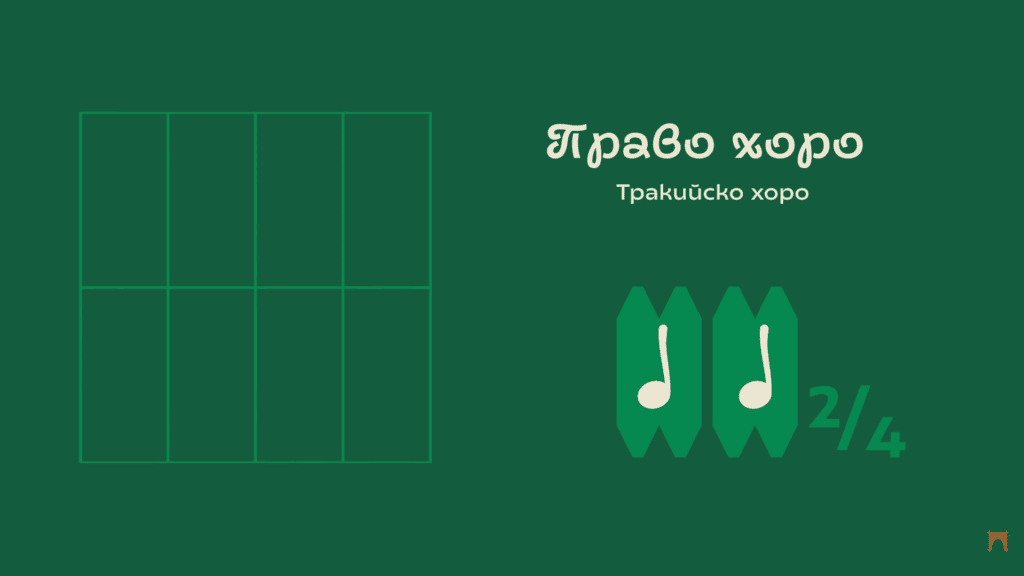
Now that we know these terms, let’s see how Taratanci’s new approach visualizes the pulse of our favorite horos. Take as an example the well-known Pravo horo in 2/4 time – an even meter made up of two beats of equal duration. In other words, one bar consists of two beats, each with the value of a quarter note. It is counted: “One, two.”
Even time signature
Here is what our new approach to visualizing traditional horos and their rhythm looks like. In a square grid with a ratio of two rows to four columns, borrowed from the 2/4 time signature, we arrange a stylized element representing the beats in a row. Each strong or weak beat within a bar is shown in a different color. The color palette is inspired by the traditional dress of the given region, and the horo figures are digitized from prints of the dancers’ actual steps.
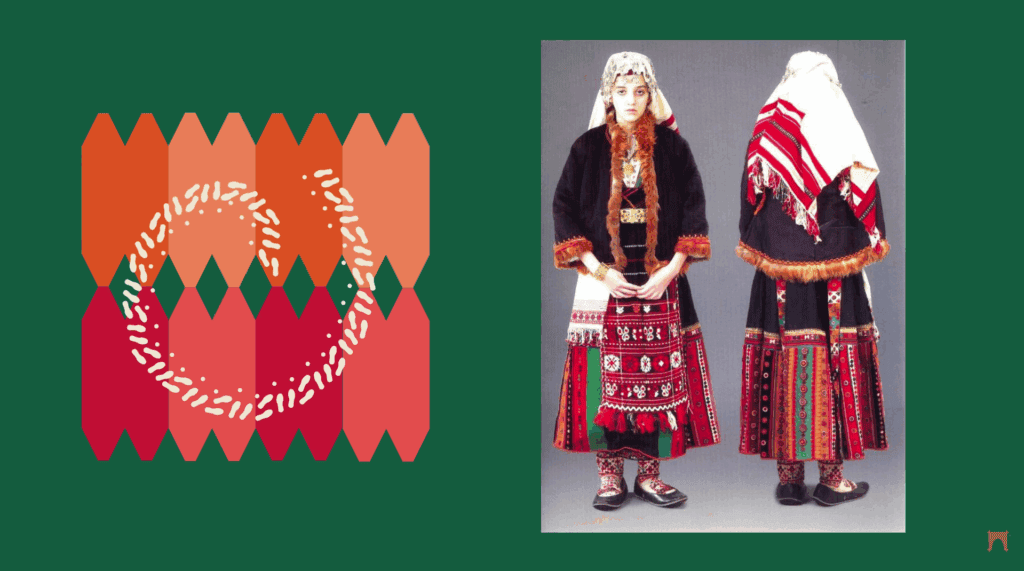
Once we have digitized the steps from a single round of the horo, the question arises of what the finished figure should look like after it has been danced many times. While collecting dance steps around the country, we learn from conversations in the field with local people, such as Denka from the “St. St. Cyril and Methodius” Community Center (chitalishte) in the village of Topoli, that most horos are danced in an open circle, in a spiral, in serpentines or in a straight line. In the past, it was mostly only certain ritual horos that were closed into a full circle. We carry this knowledge over into creating the figures and pictures of the horos.
Uneven time signature
Here is what Taratanci’s new visual approach looks like when the time signature is uneven, that is, when the beats within a bar are not equal.
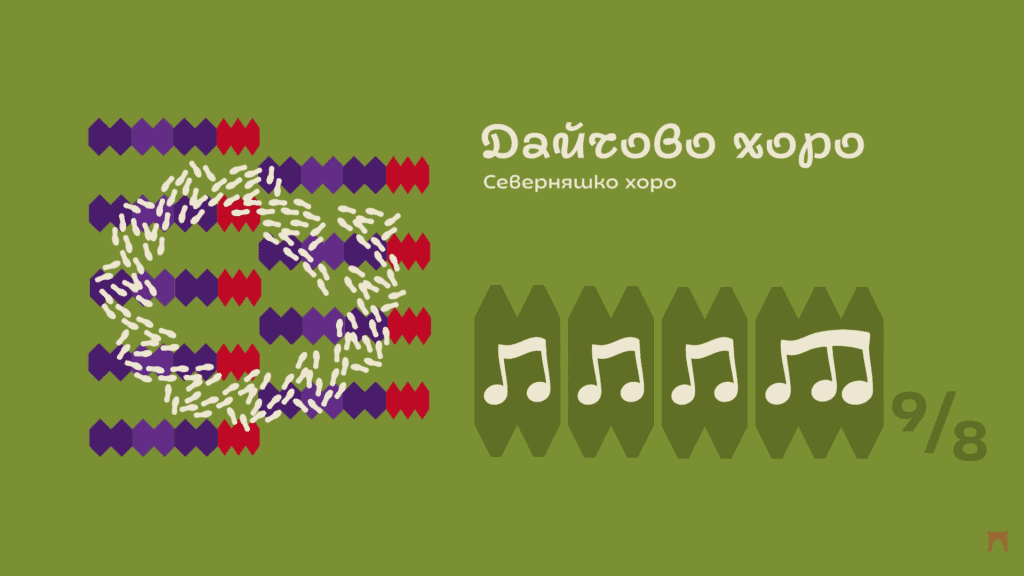
The much-loved Daychovo horo is in 9/8 time signature – one bar consists of four beats with a total value of nine eighth notes. It is counted: “One, two, three, four,” with the fourth beat.
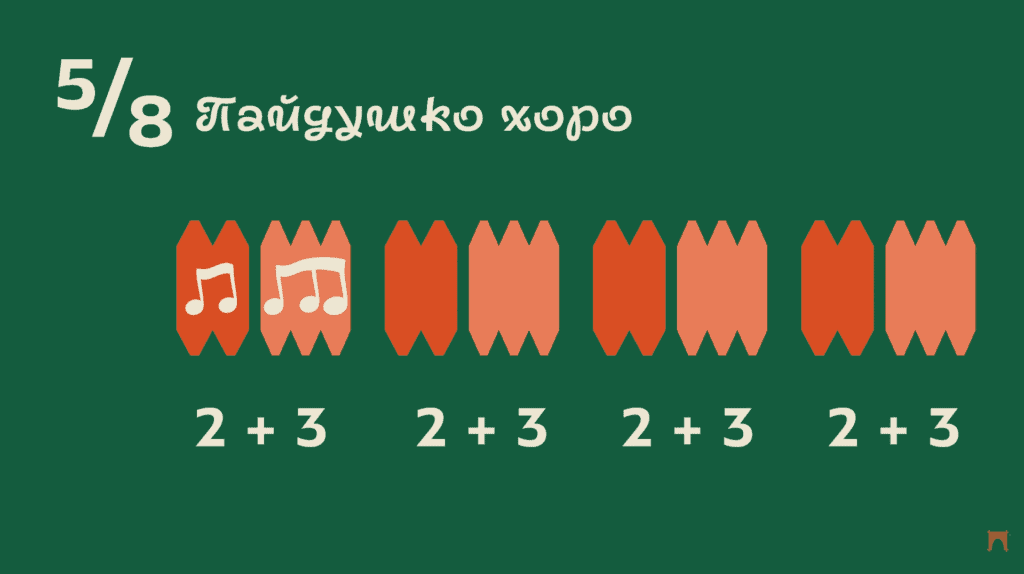
Why are some of the diamond shapes double and others triple?
Let’s look at the uneven 5/8 time signature of the Paydushko horo. It consists of two beats with a total value of five eighth notes. These two beats are not equal. The first is short, equal to two eighth notes, and is shown as a double diamond symbol. The second is long, equal to three eighth notes, and is shown as a triple diamond symbol. This shows that the numerator of the time signature reflects the number of notes, that is, the meter, while the denominator shows their note value. To give the melody variety, these eighth notes can be replaced in the composition by notes of equal total value – quarter notes, sixteenth notes and so on. But to dance in rhythm, it is quite enough to feel the pulse, that is, the rhythmic alternation of the beats.

Now that you can read the meter and keep time, can you recognize the following time signature on your own using Taratanci’s visualization? Find the answer in the video.
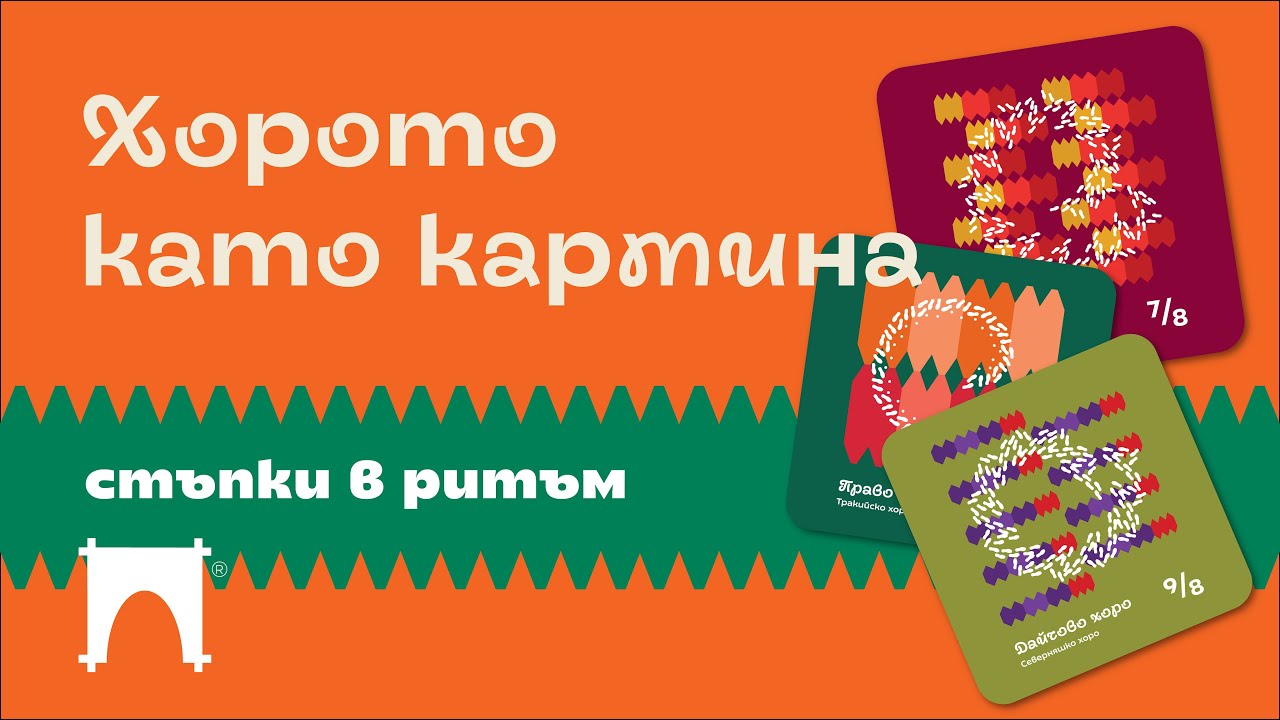
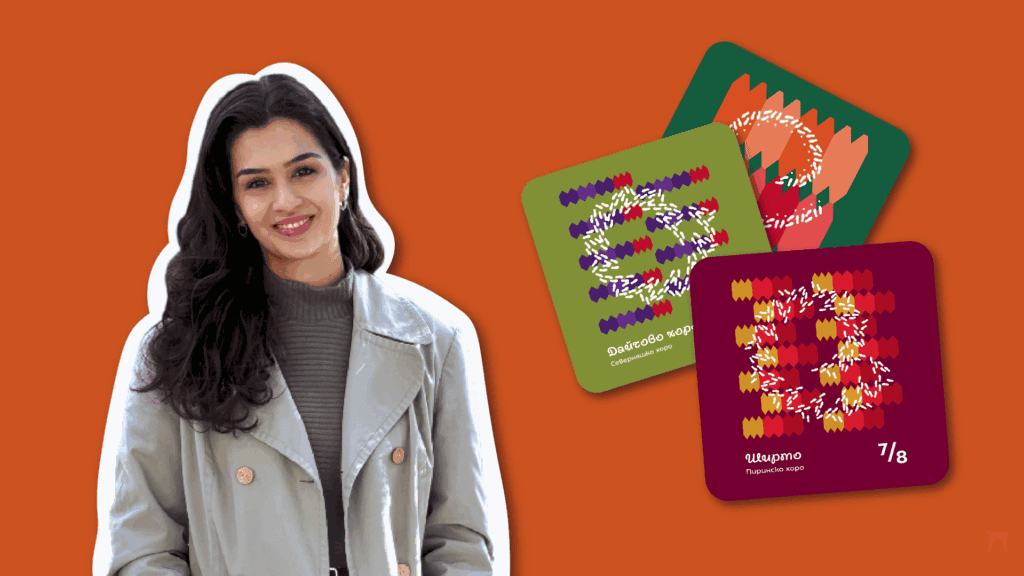
You have probably noticed by now that the new graphic figures of the horos, which we recorded in the village of Topoli last summer, look different from what you are used to. That’s because they are the work of the exceptionally talented young designer Betina Blagoeva. Her original creative style quickly gained popularity and led to a rich portfolio in which folklore finds its place, delicately but very skillfully. Betina graduated in Engineering Design with a specialization in Graphic Design from the Technical University of Sofia, and today, besides design, she also works professionally in folk dance as a dancer with the Philip Koutev National Folk Ensemble.