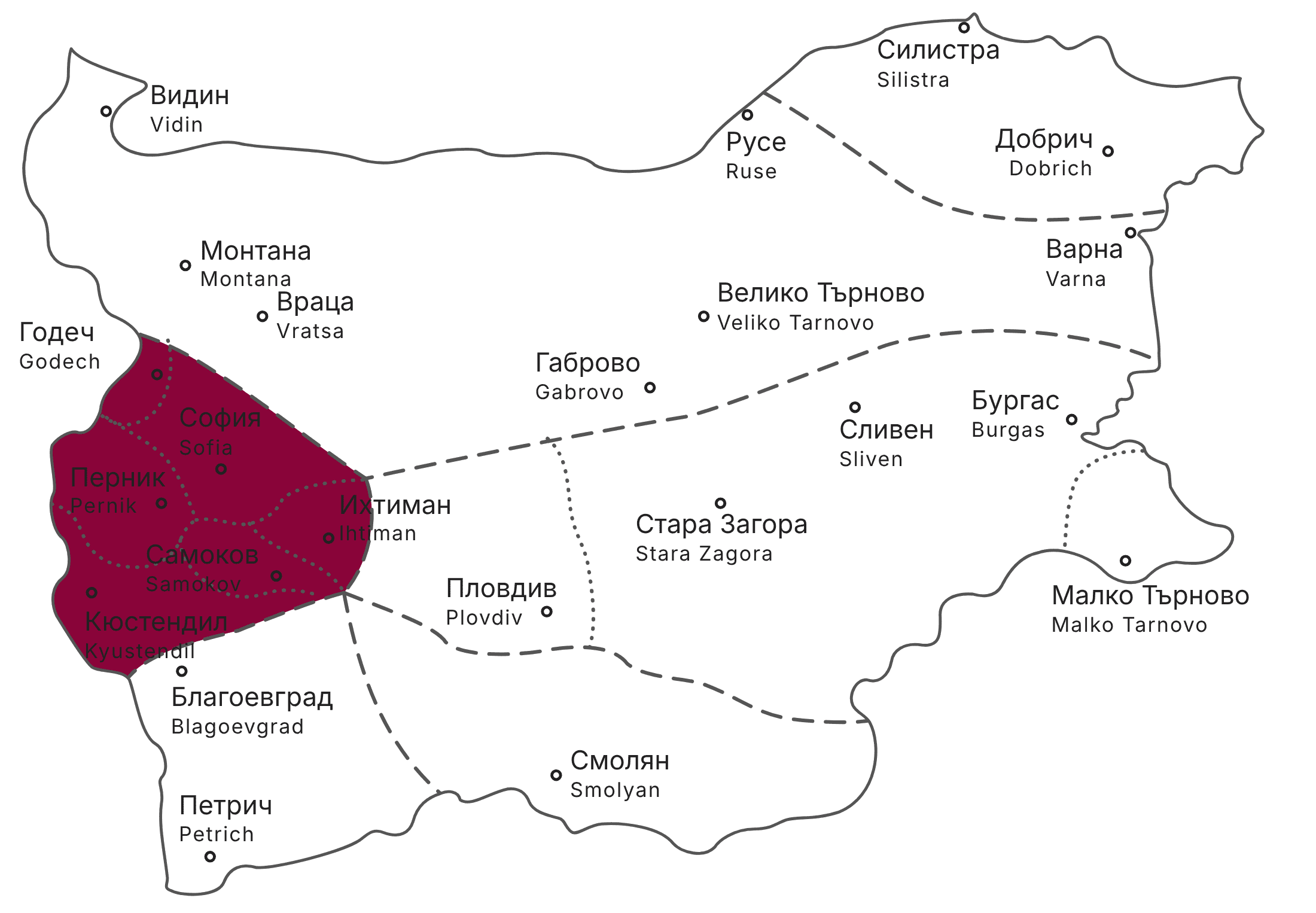
The Shopluk folklore region, also known simply as “the Shopluk”, stands out for a number of distinctive cultural features. Most of its population belongs to the Shop ethnographic group and is known collectively as “the Shopi”. Geographically, the region covers the areas of Sofia, Pernik, Tran, Breznik, Radomir, Samokov and Kyustendil.
Origin and name of the Shopi
The Shop ethnographic group took shape through a complex process between the 7th and 12th centuries. To this day, both the name and the origin of the Shopi remain unclear. P. R. Slaveykov linked the name “Shopi” to the word sop, meaning a jug or water pipe, which over time changed to shopka in the Sofia area. Whether this is true, however, no one can say for certain. Iv. Bogorov, for his part, tried to derive the name “Shopi” from Softsi or Sofiyantsi (people of Sofia). Other authors trace the etymology of “Shop” to the name of the Pecheneg tribe TCHOPY (“Tsopon”), which settled in the Sofia area centuries ago. Yet all of these theories remain mere hypotheses.
There is no consensus on the ethnic origin of the Shopi either. In the past, a large group of scholars (K. Jireček, V. Dobruský, D. Takela, Y. Ivanov and Y. Zahariev) accepted the theory that the Pechenegs (a nomadic Turkic-speaking tribe) who settled in the Sofia area left traces not only in the name of the local population but also in certain physical features of the people. Although unproven, this theory has many followers.
Another group of scholars (J. Šafařík, M. Drinov and others) linked the Shopi, both in name and in origin, to the ancient Thracian tribe of the Sapaei.
More recently, prominent ethnographers such as St. Kostov and M. Veleva, drawing on Shop costume, have declared the Shopi to be predominantly Slavic. They even believe that Shop dress has preserved Slavic elements in their purest form.
R. Sefterski, for his part, believes that the Proto-Bulgarian tribes of the Ermiar and the Kuvair played an important role in shaping the Shopi as an ethnographic group. They settled in the Sofia area at the beginning of the 9th century, when Khan Krum annexed the Sofia region and other lands south of the Balkan Mountains to Bulgaria.
As this shows, the Shopi carry traits from the cultures of the Pechenegs, the Thracians, the Slavs and the Proto-Bulgarians. Still, it was the Slavic majority that gave the Shopi their final and defining character.
Livelihood of the Shopi
After the Liberation (1878), the extended-family communes (zadrugi) broke up, and the drive for individual ownership split the land into small plots. Only in their songs could the local people dream of “a big field of white wheat and a big vineyard of white grapes” (Stoin, V., Folk Songs from the Western Outlands, 1959).
Music and musical instruments
Bulgarian folk songs are most often sung in one or two voices. Two-part folk singing is an ancient singing tradition across a large part of the country, including the Shopluk folklore region. Two-part singing is usually structured as follows: the first voice is sung by one singer and the second by several. The first voice is said to “call out”, “raise”, “ruka” or “oka”, and so its singers are called izvikachki (“callers”), izdigachki (“raisers”) and so on. The second voice is said to “drag”, “glashi” or “lay down”, and its singers are called vlekachki (“draggers”) and slagachki (“layers”).
A characteristic feature of Shop two-part singing is that the second-voice singers try to drown out the first. In their view, the best singing is when the second voice overpowers the first.
Shop two-part songs span every song genre: ritual songs, wedding songs, work songs, table songs and, above all, horo songs. The Shopi usually accompany the horo with singing. The melodies of these songs are fast, lively and playful, yet singing alone cannot achieve the whirlwind energy that instrumental accompaniment brings to the horo.
The instruments most often used in the Shopluk folklore region are the gadulka (and its variant, the kemene), the duduk, the dvoyanka and the gaida; in the past also the gusla, and less often certain other instruments (kaval, tambura, tapan).
Shop horo dances
The movements and accents in Shop dances are often directed downward, towards the ground. It is as if the Shop dancer is wrestling, crushing and trampling an imaginary opponent he has knocked to the ground. At other moments, the movements and accents are directed upward, with a clear urge to break away from the ground. To onlookers, it seems as if the Shop dancer first wrestles his opponent and then rejoices, proud of his victory.
In the structure of Shop dances, two kinds of movements can be distinguished: basic steps and action figures (the “calls”). The basic steps are Shopska, Graovka and Rachenichna. They serve as the link between the varied action figures. Action figures involve the whole body; they are broader and bigger, with more travel through space, while the basic steps are smaller and finer and are performed almost on the spot. This contrast between the two kinds of movement is an essential feature of Shop dances.
The most popular horo, danced in almost every part of the Shopluk region, is the “led” horo Za Poyas, also known as Selskoto, Shopsko za Poyas, Tarchano, Melnichkata, Ednostranka, U Mesto and others. A typical feature of its structure is that it consists of 10 measures in 2/4 time or in 7/16 with a long third beat.

Mixed “led” horo from the Tran area, from Bulgarian Folk Dances from Central Western Bulgaria by Kr. Petrov, Narodna Prosveta, 1990.
Shop folk costumes
The beautiful Shop costume, both for work and for festive occasions, is light and comfortable, which allows the Shop dance to be even more nimble, fast and whirling.
Typical of the Shopluk is the men’s “white-clad” (belodreshna) costume (in Graovo and Znepole), which is of proven Slavic origin. In the Sofia area, a transitional form between white-clad and “black-clad” (chernodreshna) men’s dress survived for a long time. In some areas, such as Kyustendil, Samokov and Ihtiman, men wore black-clad costume.
In much of the Shopluk (the Sofia, Samokov and Ihtiman areas), women’s costume is of the sukman type. Women’s dress very clearly shows a woman’s place in the family: maiden, betrothed, young bride, mother and so on. The difference is visible in individual parts of the costume, the cut of the garments, the way they are worn, the ornaments and, above all, the hairstyle and the way the headscarf is tied.
Unlike women’s costumes, men’s costumes do not reveal a Shop man’s age and status so eloquently. The difference between the costumes of older and younger men lies mainly in the decoration of the garments, the colour of the sash, the presence of extra elements and the way they are worn.

Women’s and men’s costume from the Sofia area, from Bulgarian Folk Dances from Central Western Bulgaria by Kr. Petrov, Narodna Prosveta, 1990.
The remarkable way of life of the Shopi, their dances, music and costumes have impressed many folklorists, artists, ethnographers, writers and choreographers over the years. We will regularly present their scholarly works here, in our folklore research space.
Support the cause!
In the Taratanci boutique folklore shop, you will find original, carefully selected products and experiences that elegantly carry the spirit of beautiful Bulgarian folklore into the present day. All items and workshops come from talented Bulgarian craftspeople, the Living Human Treasures of Bulgaria, whose work and skill keep the unique Bulgarian tradition alive.
By buying a gift or a lesson from the Taratanci online shop, you support Bulgarian craftspeople and preserve a piece of folklore for generations to come.